Key Points
- – Denilson Igwe claims Mark Angel withheld significant Facebook revenue earnings from him and other team members, despite supposedly generating approximately $160,000 monthly.
- – Igwe asserts he initiated the Mark Angel Comedy project, contributed heavily to its content creation, and received minimal financial compensation, with only N50,000 given in 2016 despite the show’s monetary success.
- – The controversy has polarized public opinion, with some supporting Igwe’s claims of unfair treatment while others question his motives and achievements post-split.
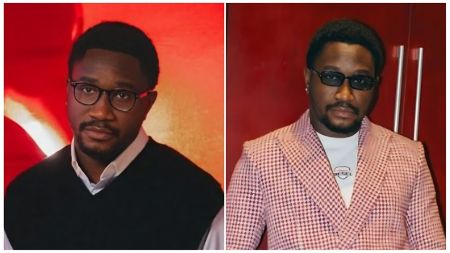
![Denilson Igwe speaking in Podcast [left]. Mark Angel posed standing and depicting a funny face [right]](https://validupdates.com/wp-content/uploads/2024/07/validupdatesimages_20240728_072115_00007698150670859902494-1024x576.jpg)
Background and allegations
Popular comedian and skit maker Denilson Igwe has spoken out about his split with former collaborator Mark Angel. Igwe shared his story in a teaser for an upcoming episode of ‘The Honest Bunch’ podcast. According to Igwe, the rift happened because he discovered that Mark was allegedly cheating him and other crew members.
In the interview, Igwe claimed that he was the one who started Mark Angel Comedy and filmed the initial content that was uploaded on Facebook. However, he was not informed when the Facebook page was monetized. “I just kept filming. Then suddenly in 2014, Mark bought a car. I asked him how he was able to afford it and he lied that someone gifted him the car and I accepted. I haven’t received a dime from Mark Angel Comedy revenue then,” Igwe stated.
Igwe went on to allege that Mark did not give him any share of the earnings from the Facebook monetization. He said that it was only in 2016, after Mark bought a car, that he received N50,000. Igwe also revealed that Mark was paying their top star Emmanuella only N20,000 monthly, despite making approximately $160,000 monthly from Facebook revenue.
Igwe’s claims on financial discrepancies
Igwe provided more details about his contributions and the lack of financial transparency. “I was the one that started Mark Angel Comedy. I’m an orphan… Mark was the elder brother of the house. He was a security guard at Kilimanjaro, GRA, Port Harcourt. I was learning camera work from a man called Ifeanyi and I stole one of the cameras. So in our own free time, we would shoot comic videos.”
He continued, “Mark then suggested that we should create a Facebook page [to post our comedy videos] which I accepted not knowing even when it was monetized. Her parents were poor so they didn’t even know the value of what their daughter was doing. No one knew the revenue it was generating. 2016 was the first time he gave me N50,000 and told me that the comedy wasn’t generating revenue. And we were making $160,000 monthly off Mark Angel Comedy’s Facebook revenue then.”
Mark Angel has yet to respond to these serious allegations.
Public reaction and netizens’ comments
The story has garnered significant attention online, with fans and viewers sharing their opinions. One user, @blochief, commented: “I wanted to ask him since he left what he has achieved by doing his own comedy, but…” This suggests a curiosity about Igwe’s accomplishments post-split.
Another user, @portharcourt_cleaning_services, highlighted the irony, saying: “You started Mark Angel Comedy. With Mark’s name. And you no use your name. Oga.” Meanwhile, @vbea.utystore24 questioned Igwe’s capabilities, stating: “Lol why you never create another Facebook account and be creating content sir if the talent dey der.”
Not everyone sided against Mark Angel. User @duchess.of.abuja had a morefavourablee view of him: “If you experience Mark in person you will duff your hat for him! Mark is a very very kind man, humble to the core!” @rhondamd72 commented on the unpredictability of human nature: “Human being? Everyone seem innocent until they get exposed.”
As the controversy unfolds, many are eagerly awaiting Mark Angel’s response to the allegations made by Igwe. The comedy duo’s fallout has not only shed light on their personal grievances but also highlighted broader issues of transparency and fairness in collaborative ventures.
For now, the public remains divided, with some sympathizing with Igwe’s plight and others questioning his motives and decisions. Whatever the case, this issue has clearly sparked a much-needed conversation about ethics and accountability in the entertainment industry.